

How Classroom Furniture Has Transformed Learning Over the Last 20 Years
As a former educator who now spends my days working alongside K-12 districts, I’ve had the rare privilege of seeing classrooms from both sides of the desk. I stood in front of students as a teacher. Today, I walk those same hallways with superintendents, principals, facility directors, and architects, helping them imagine what a classroom should be next.
One thing has become impossible to miss: classroom furniture isn’t just furniture anymore. It has become one of the most powerful tools schools have for shaping how, and how well, students learn.
Walk into a classroom built in 2005, then step into one renovated this year, and you’d be forgiven for thinking they serve two different purposes.
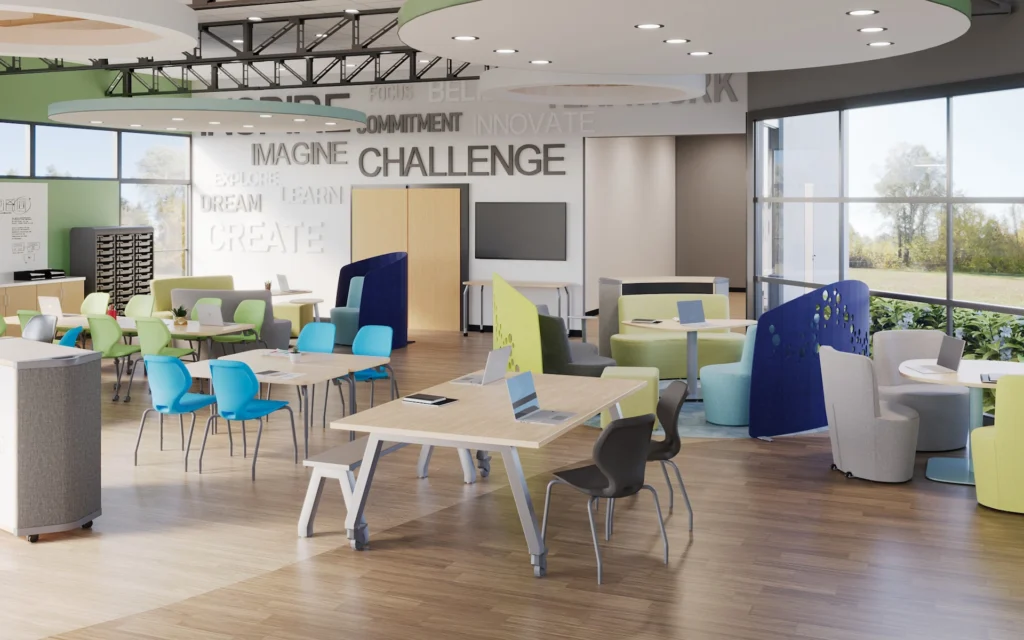
Twenty years ago, you’d find rows of heavy desks bolted or lined up facing the teacher, a chalkboard up front, and little room for anything beyond lecture-instruction. That basic arrangement, desks facing forward, had been the norm since at least the 1800s and stayed largely unchanged for generations. Today, you’re more likely to find mobile desks on casters, collaborative tables, soft seating, standing-height workstations, and charging stations built into learning zones that can transform three or four times over the course of a single day.
That shift didn’t happen because furniture manufacturers wanted to sell something new. It happened because education itself changed, and furniture finally caught up.
The Classroom Used to Be Built Around the Teacher
For decades, classroom layouts reflected one instructional model: students sat quietly, teachers delivered content, and everyone faced forward. The furniture supported durability and uniformity, not collaboration or choice. Heavy steel-framed desks and one-size-fits-all chairs were built to last generations, not to flex with different learning styles or lesson formats. At the time, which made sense, instruction was teacher-directed, and classrooms were designed to minimize distraction rather than encourage interaction.
Then Pedagogy Changed, and Furniture Had to Follow
Over the last two decades, instruction shifted toward asking students to do far more than absorb information. Today’s classrooms are built around collaboration, critical thinking, creativity, communication, project-based learning, and student voice. Those aren’t buzzwords to me; they’re the skills I watched my own students need most once they left my classroom.
This is the core idea behind what’s often called the 21st-century classroom: collaborative, student-centered learning, where students are active participants rather than passive recipients of instruction. Research backs up why the shift mattered: collaborative learning environments improve retention by giving students more time to think about, talk about, and process what they’re learning, while also strengthening student-to-student and student-to-teacher interaction.
But here’s the practical reality I saw play out in real buildings: you can’t run a collaborative, project-based lesson in a room built for silent, individual seatwork. Furniture had to evolve alongside instruction, which is when mobile desks, nesting tables, and reconfigurable layouts started becoming the new baseline rather than the exception.
Flexibility Is the New Standard
One of the biggest changes I’ve watched unfold in district after district is the move away from designing a classroom for one lesson toward designing it for an entire day of varied learning. A room might open with direct instruction, shift to small-group work 30 minutes later, become a STEM lab after lunch, and end the day with student presentations. The furniture must keep pace. Lightweight desks, flip-top tables, mobile teacher stations, and casters on nearly everything let teachers reconfigure a room in minutes instead of losing instructional time to moving heavy furniture by hand.
Kids Weren’t Built to Sit Still All Day
Because children spend roughly ten hours a day sitting, furniture increasingly needs to accommodate their natural need to move, letting them rock, bounce, or rotate while seated to support circulation and concentration rather than fighting against it. Standing desks, wobble stools, and other active-seating options aren’t about creating distraction. They’re about creating an environment where more students, not just the ones who thrive sitting still, can actually succeed.
Technology Reshaped the Furniture, Too
Twenty years ago, a desk needed enough surface for a textbook, a notebook, and a pencil. Today, most students carry a Chromebook or tablet, and furniture has adapted with larger work surfaces, integrated power, cable management, charging stations, and device storage. Technology isn’t an add-on to the lesson anymore, it’s woven into it, and the furniture has to support that seamlessly.
Classrooms Have Become Learning Ecosystems
My favorite shift to watch has been the rise of learning zones. Instead of treating every square foot of a classroom identically, teachers now carve out a collaborative project area, a quiet reading corner, soft seating for independent work, and a small-group instruction space, all in the same room. Furniture defines those zones without requiring a single wall to move.
Sustainability and Wellness Matter More Than Ever
School leaders are asking different questions when they purchase furniture today: How long will it last? Can parts be replaced instead of the whole piece? Was it made responsibly? Does it support healthier air quality? Manufacturers have responded with recycled materials and certifications for low chemical emissions, positioning sustainable furniture as both an environmental and a health decision. Trauma-informed design has entered the conversation too, with more schools building calmer spaces intended to ease student stress and support mental health, a conversation that simply wasn’t part of most furniture decisions 20 years ago.
COVID Accelerated What Was Already Underway
The pandemic didn’t start these trends, but it sped them up considerably. A meaningful share of schools modernized their furniture specifically to accommodate hybrid learning, and many reported better student engagement once flexible layouts were in place. Furniture that was easy to move, clean, and reconfigure suddenly mattered more than ever, and many districts discovered that flexible classrooms didn’t just solve a pandemic-era problem. They created better learning environments, full stop.
The Classroom Is No Longer Just a Room
What I try to help every district understand is that furniture isn’t the final line item in a construction budget. It’s one of the first real investments in the student experience. The right environment supports better instruction, invites collaboration, gives students ownership of how they learn, and gives teachers the freedom to teach the way they know works.
Looking ahead, I expect the pace to keep accelerating, height-adjustable furniture as a default rather than an upgrade, spaces designed specifically for neurodiverse learners, AI-assisted space planning, and modular systems built to evolve alongside curriculum rather than get replaced by it.
If the last 20 years have taught me anything, it’s this: the classroom is no longer just a place where learning happens. It has become part of the lesson itself. As educators, designers, and industry partners, we have a real opportunity, and responsibility, to build spaces that inspire curiosity, encourage collaboration, and help every student succeed. Because when we design better learning environments, we’re not just furnishing classrooms. We’re investing in the future of education.
Andres Tolentino is the workplace consultant – education at LOTH, Inc., a workplace solutions company with 135 years of experience helping organizations create inspiring, high-performing environments through commercial furniture, interior construction, design services, technology integration, and managed services, www.lothinc.com. He also brings 15 years of experience in K–12 education, spanning classroom instruction, school operations, and executive leadership.
Source: Christian Schools Products